


Read our 2025 annual report

Knowledge Hub
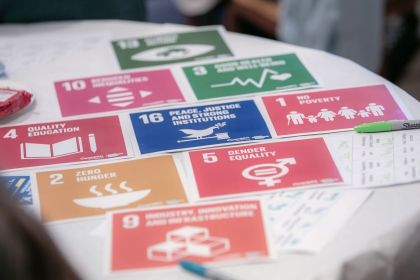
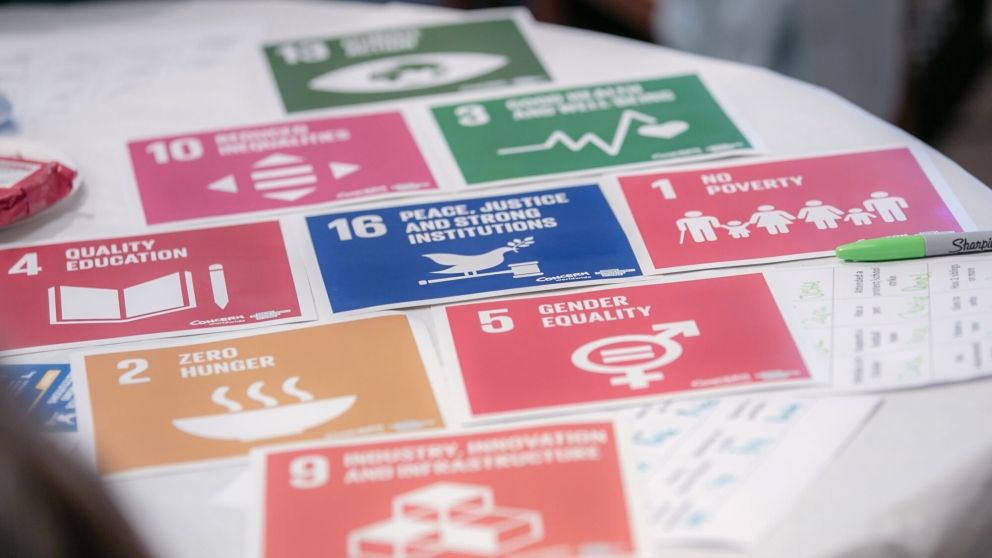
Agenda 2030 is the world's biggest group project. Explore the 17 Sustainable Development Goals, where progress stands today, and how we can still save them.
The Global Goals. The Sustainable Development Goals. Agenda 2030. They have many names, but one overarching aim: to end poverty, protect our planet, and achieve a better, fairer, and more sustainable future for all.
The Sustainable Development Goals (or SDGs) are a shared global blueprint for tackling some of the biggest challenges facing our world.
Adopted by all UN member states in 2015, the 17 goals aim to end poverty by 2030 by addressing many of its causes in an integrated and intentional way.
In 2026, the clock is ticking: So far, it’s unlikely that we will fully realise any of these goals by 2030, and only 35% of the individual targets attached to each goal are on track. In some cases, progress has even reversed. But that doesn’t mean that we should abandon the progress we’ve already made, or the belief in a better future. Here’s what you need to know.
Why do we have the Sustainable Development Goals?
In 2001, all of the UN member states adopted the Millennium Development Goals. These were eight goals (each containing several targets) designed to be met by 2015:
- Eradicate extreme poverty and hunger
- Achieve universal primary education
- Promote gender equality and empower women
- Reduce child mortality
- Improve maternal health
- Combat HIV/AIDS, malaria, and other diseases
- Ensure environmental sustainability
- Develop a global partnership for development
These goals expired in 2015, although there were some strong gains made in this time: By 2010, the number of people living below the poverty line in low-income countries (measured at the time at $1.25 a day) was half the number it was in 1990. A 2017 Brookings Institute study concluded that somewhere between 21 and 29 million lives were saved thanks to the accelerated progress set out by the MDGs.
While the Millennium Development Goals weren’t met, conservative estimates suggest that they saved between 21 and 29 million lives through accelerated development progress.
At the time, the MDGs gave us the most successful anti-poverty movement in history, but there was far more work to be done. After the UN analysed what worked and what didn’t, they came to the conclusion that the MDGs were focused on poverty, hunger, and inequality, but they didn’t do enough to address the root causes of these issues.
That’s where the Sustainable Development Goals come in.
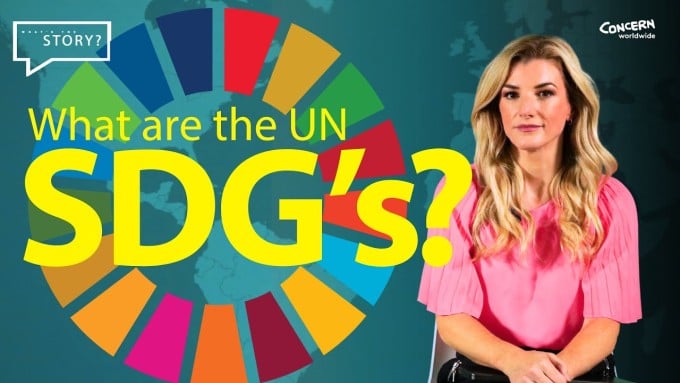

What are the Sustainable Development Goals?
In the same year that the MDGs expired, the UN’s General Assembly launched the Sustainable Development Goals, with 150 world leaders representing 193 countries all committing to work towards these goals through national policies.
Instead of eight goals, the SDGs comprised 17 goals, 169 targets to determine whether those goals are met, and several hundred indicators used to measure progress towards achieving these goals and targets. The goals build on the core of the MDGs, with additions that take a closer look at some of the root causes of poverty:
- Goal 1: End poverty in all its forms everywhere
- Goal 2: End hunger, achieve food security and improved nutrition, and promote sustainable agriculture
- Goal 3: Ensure healthy lives and promote well-being for all at all ages
- Goal 4: Ensure inclusive and equitable quality education and promote lifelong learning opportunities for all
- Goal 5: Achieve gender equality and empower all women and girls
- Goal 6: Ensure availability and sustainable management of water and sanitation for all
- Goal 7: Ensure access to affordable, reliable, sustainable, and modern energy for all
- Goal 8: Promote sustained, inclusive and sustainable economic growth, full and productive employment, and decent work for all
- Goal 9: Build resilient infrastructure, promote inclusive and sustainable industrialization, and foster innovation
- Goal 10: Reduce inequality within and among countries
- Goal 11: Make cities and human settlements inclusive, safe, resilient, and sustainable
- Goal 12: Ensure sustainable consumption and production patterns
- Goal 13: Take urgent action to combat climate change and its impacts
- Goal 14: Conserve and sustainably use the oceans, seas, and marine resources for sustainable development
- Goal 15: Protect, restore, and promote sustainable use of terrestrial ecosystems, sustainably manage forests, combat desertification, halt and reverse land degradation, and halt biodiversity loss
- Goal 16: Promote peaceful and inclusive societies for sustainable development, provide access to justice for all, and build effective, accountable, and inclusive institutions at all levels
- Goal 17: Strengthen the means of implementation and revitalise the global partnership for sustainable development


Are we on track to meeting the goals by 2030?
In short, no. The UN’s most recent report from earlier this year shows that only 35% of SDG targets are on track or making modest gains. Nearly half are progressing too slowly, and 18% are actually regressing.
Over 800 million people still live in extreme poverty. One out of every 11 people still faces hunger, and one out of every four lives without access to safe drinking water or adequate sanitation infrastructure. Women still perform 2.5 times the amount of unpaid care work than men, and people with disabilities remain underserved across all sectors.
In the last decade, conflict, climate disasters, economic instability, a global pandemic, and rising geopolitical tensions have, as the UN notes, all put pressure on the SDGs. We see this in the numbers as well: the global refugee crisis has grown since the SDGs were adopted, CO₂ levels are at their highest in over 2 million years, and debt service costs for low- and middle-income countries hit $1.4 trillion last year – money that could be put towards development.

But…
That all said, we have still made incredible progress that should be recognised. The UN notes several milestones in the same progress report:
- Over half of the world’s population is now covered by some form of social protection – 10% more than a decade ago
- Child marriage, maternal mortality, and child mortality have all declined
- Women now hold 27% of parliamentary seats around the world (up from 22%)
- New HIV infections are down 39% since 2010
- Malaria prevention efforts have saved 12.7 million lives
- Over 110 million more children are in school, and the gender gap in education continues to shrink
- Access to electricity has reached 92% of the global population, and internet use jumped from 40% in 2015 to 68% in 2024
- Conservation efforts have helped to double the protection for vital ecosystems
With four years to go, there is still room for incredible progress to be made with the right support, investment, and commitment. What’s more, even if none of these goals are fully realised around the world in 2030, that doesn’t undo the success that we have seen over the last decade.


Who’s responsible for meeting these goals – and how much will it cost to realise them?
The SDGs were developed as a compass for countries to align national plans with international commitments, so ultimately the responsibility for meeting these goals rests with each individual country and their leaders.
However, the SDGs represent perhaps the largest group project in our world to-date. Governments must work with local communities, the private sector, NGOs, other governments, and multilateral agencies to make these goals a reality.
The strategies needed to fully achieve these goals will also take a great deal of investment. The UN estimates that, in order to achieve the SDGs across all sectors, we will need to invest $5 to $7 trillion (USD) per year into programming.

This seems like a high number, but the UN also estimates that total global financial assets are roughly $200 trillion. That means financing is available, but it’s not being put towards sustainable development at the speed and scale needed to reach the goals by 2030. In recent years, we’ve fallen $4 trillion short of this $5-$7 trillion benchmark. Last year, this led to the Sevilla Commitment, in which countries agreed to:
- More effectively mobilise and channel financial resources.
- Strengthen debt relief programmes.
- Enhance domestic resource mobilisation.
- Promote greater transparency and cooperation to close the financing gap.
This is a good step forward, but 2025 was also a year marked by crisis fatigue and funding cuts to many critical humanitarian and development programmes. Agreements are a crucial starting point, but maintaining momentum now is what will determine whether millions of people are able to break the cycle of poverty for good.

How Concern works to support the Sustainable Development Goals
While Concern’s current programmes don’t support all 17 Sustainable Development Goals, our mission at the end of the day is to end extreme poverty. All of our programmes touch on at least a few SDGs and help communities pursue the related indicators and targets.
In 2025, our programmes supported the following SDGs:
- End poverty (SDG 1)
- Zero hunger (SDG 2)
- Good health and wellbeing (SDG 3)
- Quality education (SDG 4)
- Gender equality (SDG 5)
- Clean water and sanitation (SDG 6)
- Decent work and economic growth (SDG 8)
- Reduced inequalities (SDG 10)
- Climate action (SDG 13)
- Peace, justice, and strong institutions (SDG 16)
- Partnership for the goals (SDG 17)
You can learn more about our work to support the SDGs through our 2025 Annual Report.


